

ICENI vs. Traditional MCUs
A Hardware-Enforced Security Analysis
ICENI vs. Traditional MCUs: A Hardware-Enforced Security Analysis
There are a number of ways that ICENI offers a more secure solution versus product available in the market today. Let’s look at them in a bit more detail.
1. Memory Safety Built-In
Traditional MCUs typically rely on software-only techniques (such as coding guidelines, static analysis, or runtime checks) to prevent memory safety issues like buffer overflows or use-after-free.
ICENI, being based on CHERI (Capability Hardware Enhanced RISC Instructions), enforces memory safety directly in hardware:
- Every pointer is a capability, with bounds, permissions, and provenance baked in.
- This prevents many classic memory exploits (buffer overflows, stack smashing, return-oriented programming) at the hardware level, not just by software defences.
2. Fine-Grained Compartmentalization
- On a traditional MCU, isolation usually requires a heavyweight RTOS or even a hypervisor, which increases attack surface.
- Iceni provides hardware-enforced compartments at a much smaller footprint.
- Each component can only access the memory and functions explicitly delegated to it, so a compromised module can’t escalate privileges or access unrelated parts of the system.
3. Lower Overhead Security
- Traditional MCUs often depend on MPUs (Memory Protection Units) or MMUs, which protect regions of memory at a coarse level.
- Iceni’s capabilities provide per-pointer protection, so security checks are more precise and less costly than trapping into an OS.
- This allows tighter security guarantees with less performance penalty.
4. Resilience Against Modern Exploits
- Attacks like ROP (Return-Oriented Programming), JOP (Jump-Oriented Programming), and pointer forgery are still possible on classical MCUs.
- Iceni’s unforgeable capabilities mean an attacker cannot craft a malicious pointer in software.
- Even if a vulnerability exists, the scope of exploitation is drastically reduced because compromised code is locked inside its compartment.
5. Security by Default
- On a normal MCU, developers must consciously add mitigations, sandboxing, and runtime checks.
- Iceni enforces safety by construction—all memory access and compartment boundaries are checked automatically.
- This reduces developer burden and human error, a common source of vulnerabilities in embedded systems.
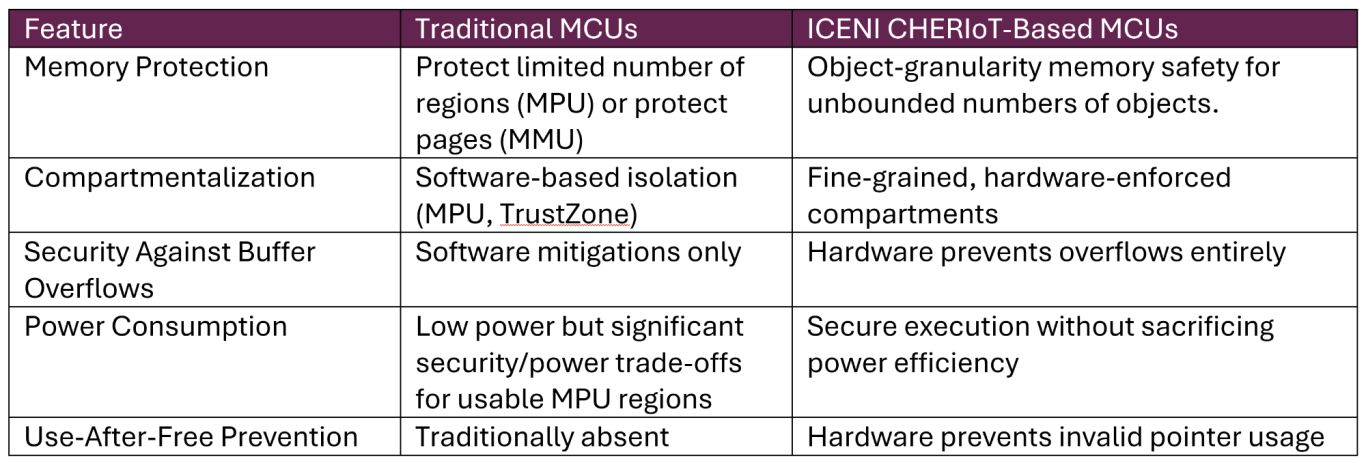
Summary
Iceni improves security over a traditional MCU because it integrates hardware-enforced memory safety and compartmentalization at the instruction set level. This makes it inherently resistant to memory corruption attacks, providing strong isolation between components, and reducing reliance on complex software mitigations—all with lower overhead and improved assurance.
Find out more about ICENI – Contact Us now.
